For UAE, Kuwait, Bahrain, Qatar and Oman Healthcare Professionals Only
WAINUA is indicated for the treatment of the polyneuropathy of hereditary transthyretin-mediated amyloidosis in adults.

STUDY DESIGN
The NEURO-TTRansform trial studied the efficacy
and safety of WAINUA in adults with hATTR-PN1,2
A phase 3, randomized, open-label, externally controlled, multicenter study1-3
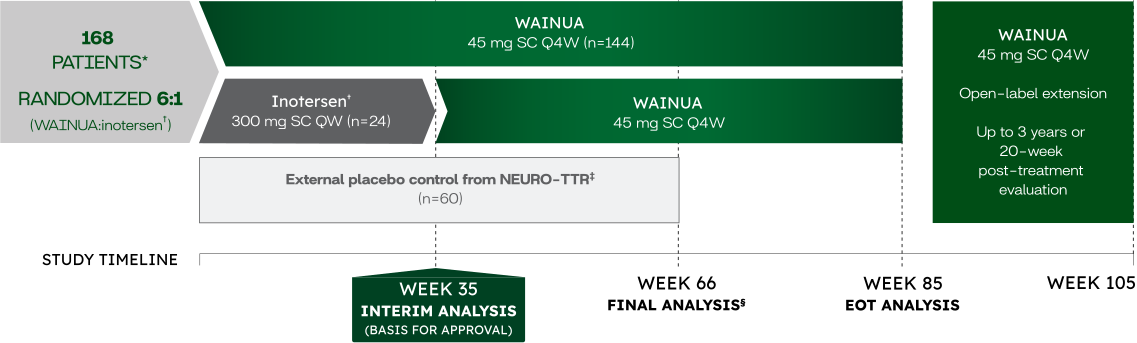
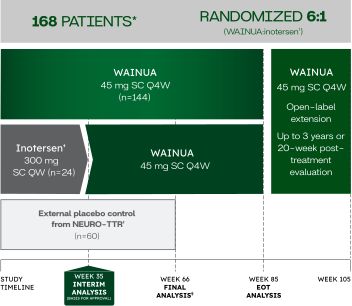
The external placebo control from NEURO-TTR was appropriate because of similar eligibility criteria and endpoints1,3,4
*Patients included in NEURO-TTRansform were 18 to 82 years of age, and had a confirmed diagnosis of hATTR-PN as defined by all of the following: Stage 1 (ambulatory without assistance) or Stage 2 (ambulatory with assistance) familial amyloid polyneuropathy or Coutinho stage; documented mutation of the TTR gene; and signs and symptoms consistent with hATTR-PN, including NIS ≥10 and ≤130. Patients must have discontinued active treatment with any other approved drug for hATTR 2 weeks prior to study.2,3
†The inotersen reference group was intended to confirm sufficiently comparable disease progression and treatment response patterns between NEURO-TTR and NEURO-TTRansform trials.3
‡All endpoints were compared with the placebo arm of the earlier NEURO-TTR trial (NCT01737398).1,2,4
§The final analysis endpoints were distributed over 2 visits (Week 65 and Week 66), as prespecified in the protocol.3
WEEK 35 Interim Analysis Efficacy Endpoints1-3
Co-primary Endpoints:
SERUM TTR
% CHANGE FROM BASELINE vs PLACEBO AT WEEK 35
mNIS+7
CHANGE FROM BASELINE
vs PLACEBO AT WEEK 35
Key Secondary Endpoint:
NORFOLK QoL-DN
CHANGE FROM BASELINE vs PLACEBO AT WEEK 35


WEEK 66 FINAL ANALYSIS EFFICACY ENDPOINTS2,3
Co-primary Endpoints:
SERUM TTR
% CHANGE FROM BASELINE
vs PLACEBO AT WEEK 65
mNIS+7
CHANGE FROM BASELINE
vs PLACEBO AT WEEK 66
NORFOLK QoL-DN
CHANGE FROM BASELINE
vs PLACEBO AT WEEK 66
Key Secondary Endpoint:
mBMI
CHANGE FROM BASELINE
vs PLACEBO AT WEEK 65
WEEK 85 EOT ANALYSIS POST HOC AND EXPLORATORY ENDPOINTS2,3
Post Hoc Endpoint:
SERUM TTR
% CHANGE FROM BASELINE AT WEEK 85
Exploratory Endpoints:
mNIS+7
CHANGE FROM BASELINE
AT WEEK 85
NORFOLK QoL-DN
CHANGE FROM BASELINE
AT WEEK 85
COMPASS-31
CHANGE FROM BASELINE
AT WEEK 81
Discover the powerful efficacy of WAINUA


Explore the safety profile of WAINUA
FOOTNOTES
COMPASS-31, Composite Autonomic Symptom Score-31; EOT, end of treatment; hATTR, hereditary transthyretin-mediated amyloidosis; hATTR-PN, polyneuropathy of hereditary transthyretin-mediated amyloidosis; mBMI, modified body mass index; mNIS+7, modified Neuropathy Impairment Score +7; NIS, Neuropathy Impairment Score; Norfolk QoL-DN, Norfolk Quality of Life-Diabetic Neuropathy; Q4W, every 4 weeks; QW, every week; SC, subcutaneous; TTR, transthyretin.
REFERENCES
- 1. WAINUA® (eplontersen) [prescribing information]. Wilmington, DE: AstraZeneca Pharmaceuticals LP; 2025.
- 2. Coelho T, Ando Y, Benson MD, et al. Design and rationale of the global phase 3 NEURO-TTRansform study of antisense oligonucleotide AKCEA-TTR-LRx (ION-682884-CS3) in hereditary transthyretin-mediated amyloid polyneuropathy. Neurol Ther. 2021;10(1):375-389.
- 3. Coelho T, Marques W Jr, Dasgupta NR, et al. Eplontersen for hereditary transthyretin amyloidosis with polyneuropathy [article and supplementary online content]. JAMA. 2023;330(15):1448-1458.
- 4. Benson MD, Waddington-Cruz M, Berk JL, et al. Inotersen treatment for patients with hereditary transthyretin amyloidosis. N Engl J Med. 2018;379(1):22-31.
IMPORTANT SAFETY INFORMATION
WARNINGS AND PRECAUTIONS
- Reduced Serum Vitamin A Levels and Recommended Supplementation WAINUA leads to a decrease in serum vitamin A levels. Supplement with recommended daily allowance of vitamin A. Refer patient to an ophthalmologist if ocular symptoms suggestive of vitamin A deficiency occur.
ADVERSE REACTIONS
Most common adverse reactions (≥9% in WAINUA-treated patients) were vitamin A decreased (15%) and vomiting (9%).
INDICATION
WAINUA injection, for subcutaneous use, 45 mg is indicated for the treatment of the polyneuropathy of hereditary transthyretin-mediated amyloidosis
in adults.