For UAE, Kuwait, Bahrain, Qatar and Oman Healthcare Professionals Only

WAINUA is indicated for the treatment of the polyneuropathy of hereditary transthyretin-mediated amyloidosis in adults.

DISEASE MANIFESTATIONS
hATTR is a rapidly progressive and fatal disease that requires timely recognition of symptoms1

Clinical manifestations are variable depending on specific mutation, patient population, and age2
The majority of patients with hATTR have a mixed phenotype*3-9
WAINUA is not indicated for the treatment of cardiomyopathy symptoms.


Peripheral neuropathy10-13
- Rapidly progressive, painful neuropathy in hands and feet
- Muscle weakness, difficulty walking, and balance disorder


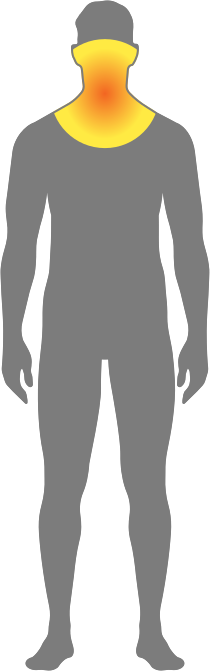
Autonomic neuropathy10,13,14
- GI symptoms of dysautonomia: constipation/diarrhea10
- Orthostatic hypotension10
- Sexual dysfunction14


Gastrointestinal†10,11,13,14
- Weight loss
- Early satiety


Musculoskeletal11-13,15
- Carpal tunnel syndrome11-13
- Knee or hip surgery12,15
- Lumbar spinal stenosis


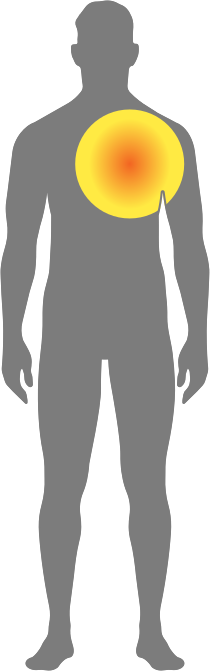
Cardiac10,13,14,16
- Heart failure (included HFpEF)
- Poor tolerance to standard HF GDMT
- Atrial fibrillation
- Conduction abnormalities
- Peripheral edema
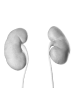
Nephropathy10
- Proteinuria
- Renal failure
- Rapidly progressive, painful neuropathy in hands and feet
- Muscle weakness, difficulty walking, and balance disorder
- GI symptoms of dysautonomia: constipation/diarrhea10
- Orthostatic hypotension10
- Sexual dysfunction14
- Weight loss
- Early satiety
- Carpal tunnel syndrome11-13
- Knee or hip surgery12,15
- Lumbar spinal stenosis
- Heart failure
(included HFpEF) - Poor tolerance to standard HF GDMT
- Atrial fibrillation
- Conduction abnormalities
- Peripheral edema
- Proteinuria
- Renal failure




This is not a complete list of symptoms associated with hATTR. Each patient’s experience is different and may not exhibit all these symptoms collectively or at the same time. ATTR symptoms may worsen over time.1
*A mixed phenotype combines features of both cardiomyopathy and polyneuropathy.17
†Gastrointestinal symptoms are often considered autonomic symptoms.10

Evaluate the signs and symptoms of hATTR


Discover the powerful efficacy of WAINUA
FOOTNOTES
ATTR, transthyretin-mediated amyloidosis; GDMT, guideline-directed medical therapy; GI, gastrointestinal; hATTR, hereditary transthyretin-mediated amyloidosis; HF, heart failure; HFpEF, heart failure with preserved ejection fraction.
REFERENCES
- 1. Adams D, Algalarrondo V, Polydefkis M, Sarswat N, Slama MS, Nativi-Nicolau J. Expert opinion on monitoring symptomatic hereditary transthyretin-mediated amyloidosis and assessment of disease progression. Orphanet J Rare Dis. 2021;16(1):411.
- 2. Ando Y, Coelho T, Berk JL, et al. Guideline of transthyretin-related hereditary amyloidosis for clinicians. Orphanet J Rare Dis. 2013;8:31.
- 3. Bazell C, Alston M, Kumar N, et al. Descriptive characteristics of patients diagnosed with transthyretin amyloidosis (ATTR) in the Medicare fee-for-service and commercial populations. Poster presented at: International Symposium of Amyloidosis; May 26-30, 2024; Rochester, Minnesota.
- 4. Planté-Bordeneuve V, Said G. Familial amyloid polyneuropathy. Lancet Neurol. 2011;10(12):1086-1097.
- 5. Adams D, Ando Y, Beirão JM, et al. Expert consensus recommendations to improve diagnosis of ATTR amyloidosis with polyneuropathy. J Neurol. 2021;268(6):2109-2122.
- 6. Swiecicki PL, Zhen DB, Mauermann ML, et al. Hereditary ATTR amyloidosis: a single-institution experience with 266 patients. Amyloid. 2015;22(2):123-131.
- 7. Waddington-Cruz M, Wixner J, Amass L, Kiszko J, Chapman D, Ando Y; THAOS Investigators. Characteristics of patients with late- vs. early-onset Val30Met transthyretin amyloidosis from the Transthyretin Amyloidosis Outcomes Survey (THAOS). Neurol Ther. 2021;10(2):753-766.
- 8. Pinto MV, Pinto LF, Dias M, et al. Late-onset hereditary ATTR V30M amyloidosis with polyneuropathy: characterization of Brazilian subjects from the THAOS registry. J Neurol Sci. 2019;403:1-6.
- 9. Sattianayagam PT, Hahn AF, Whelan CJ, et al. Cardiac phenotype and clinical outcome of familial amyloid polyneuropathy associated with transthyretin alanine 60 variant. Eur Heart J. 2012;33(9):1120-1127.
- 10. Gertz M, Adams D, Ando Y, et al. Avoiding misdiagnosis: expert consensus recommendations for the suspicion and diagnosis of transthyretin amyloidosis for the general practitioner. BMC Fam Pract. 2020;21(1):198.
- 11. National Institute for Health and Care Excellence. Highly specialised technology evaluation: inotersen for treating hereditary transthyretin-related amyloidosis [ID1242]. 2018.
- 12. Nativi-Nicolau JN, Karam C, Khella S, Maurer MS. Screening for ATTR amyloidosis in the clinic: overlapping disorders, misdiagnosis, and multiorgan awareness. Heart Fail Rev. 2022;27(3):785-793.
- 13. Conceição I, González-Duarte A, Obici L, et al. "Red-flag"-symptom clusters in transthyretin familial amyloid polyneuropathy. J Peripher Nerv Syst. 2016;21(1):5-9.
- 14. Gonzalez-Duarte A, Valdés-Ferrer SI, Cantú-Brito C. Characteristics and natural history of autonomic involvement in hereditary ATTR amyloidosis: a systematic review. Clin Auton Res. 2019;29(suppl 1):1-9.
- 15. Rubin J, Alvarez J, Teruya S, et al. Hip and knee arthroplasty are common among patients with transthyretin cardiac amyloidosis, occurring years before cardiac amyloid diagnosis: can we identify affected patients earlier? Amyloid. 2017;24(4):226-230.
- 16. Kittleson MM, Ruberg FL, Ambardekar AV, et al; Writing Committee. 2023 ACC Expert Consensus Decision Pathway on comprehensive multidisciplinary care for the patient with cardiac amyloidosis: a report of the American College of Cardiology Solution Set Oversight Committee. J Am Coll Cardiol. 2023;81(11):1076-1126.
- 17. Brito D, Albrecht FC, de Arenaza DP, et al. World Heart Federation consensus on transthyretin amyloidosis cardiomyopathy (ATTR-CM). Glob Heart. 2023;18(1):59.
IMPORTANT SAFETY INFORMATION
WARNINGS AND PRECAUTIONS
- Reduced Serum Vitamin A Levels and Recommended Supplementation WAINUA leads to a decrease in serum vitamin A levels. Supplement with recommended daily allowance of vitamin A. Refer patient to an ophthalmologist if ocular symptoms suggestive of vitamin A deficiency occur.
ADVERSE REACTIONS
Most common adverse reactions (≥9% in WAINUA-treated patients) were vitamin A decreased (15%) and vomiting (9%).
INDICATION
WAINUA injection, for subcutaneous use, 45 mg is indicated for the treatment of the polyneuropathy of hereditary transthyretin-mediated amyloidosis in adults.